No EULA required

Open source software should not force acceptance of an End User License Agreement (EULA). In every context where an “EULA” is appropriately used, it’s describing the rights that an end-user and not a distributor is surrendering in return for the freedom to perform an act that would otherwise breach the copyright. The freedoms you need to use the software under open source licenses are granted unconditionally, and the freedoms you need to distribute and modify the software are conditioned on acts other than signalling acceptance of the license with a signature or a click-through.

I thus continue to assert that it is always unnecessary for open source software to present users with the license and demand an act of submission before proceeding. Demanding such an act is to be discouraged; it conditions users to believe that use of the software is subject to compliance actions.

There’s never a need for compliance or enforcement action on mere use (as opposed to distribution or modification). As has been written elsewhere, the freedom to use without seeking permission or proof of compliance is actually the key benefit of open source software and slavish recital of redundant EULA behaviour distracts users from this truth.
WWW: Why the Web Worked and Gopher didn’t

The document CERN signed that made the technology behind the World Wide Web available without restrictions to everyone in the world showed up recently as part of CERN’s celebration of 20 years of the open web. Back at the start of the 90s, I was at IBM working on video conferencing (you’ll still find my name next to the well-known port number allocation for it), and among my responsibilities was making information available on the newly-popular Internet. We had a web page for our project, and did consider the idea of publishing information through another, much more widely used technology of the time – called Gopher. However, doing so was more complicated, and also we were concerned that running our own server might require some sort of license. So we stuck with just a web page.

Our experience was duplicated all over the world. Despite being very widely used, Gopher stagnated in the face of an open alternative. People don’t like to have to ask permission to get their job done, so given a choice between a technology that can be used without having to seek permission and one which requires approval from its owner (and all the corresponding bureaucracy that goes with that with ones employer) the decision is easy.

People have asked “what would have happened if the Web was patented”. The answer is there would never have been a web. It would have been an interesting project stuck in a lab somewhere, unable to get any traction against the more widely used Gopher and probably never heard of. What made the WWW was CERN’s decision to make it freely available. We should be immeasurably grateful for that enlightened decision.

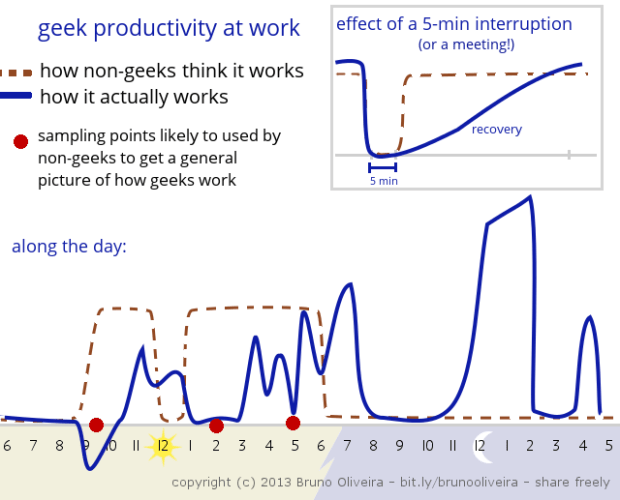
It’s a public holiday here in the UK today, so here’s a truthy graph instead:

Geek Productivity

Geek Productivity

Did you miss the year of the Linux Desktop?

Back in August last year you might have seen Miguel de Icaza’s blog post “What Killed the Linux Desktop“. Since then a debate has been smouldering yet again in the Linux community with regard to whether the “year of the Linux Desktop” is still an achievable dream. Google’s Chromebook is one solid response to that question. It runs a stripped down, single function Linux system that’s easily maintained and secured centrally.

But the reason it should really be considered an answer to the question of the supremacy of Linux is its focus on the browser. The browser has overtaken the desktop as the prime location for applications. Linux based applications form the backbone of today’s computer usage, being the powerhouse behind the majority of applications people actually use. The real metric is not replacement of Windows; it’s replacement of Windows applications. Read more and have your say in today’s InfoWorld article.

What does the Special 301 really reveal?

This week the United States Trade Representative (USTR) released the annual Special 301 Report. For those of you who are not aware of this report, it assesses the standard to which America’s international trading partners “uphold intellectual property rights protection and enforcement”. Of the ninety five countries assessed, forty one have then been put into the report itself. The report consists of  a series of watch lists, of countries that to a greater or lesser degree fail to meet the standards desired by the USTR.

How effective an indicator of intellectual property rights protection does this survey really offer? Continue reading

Open Source Accounting Solution for Non-Profits

Non-profit organisations are faced with an unappetising choice when deciding on a software solution for their accounting needs. They can either develop and maintain a complicated system of their own or they can use propriety software which undermines their charitable, equality focussed basis. This conflict between ideological desire and practical needs is likely to be particularly heartfelt for open source and free software non-profits.
 
Software Freedom Conservancy has a solution to propose. They plan to first survey existing solutions developed for for-profit accounting needs and then develop from the best available system an open source solution focussed specifically on the needs of non-profit organisations. When completed this software should save the sector millions each year as well as increasing its collaborative potential.
 
The Conservancy is itself a charity and is looking for financial help to fund the development of this software. Today they announced the start of a campaign to raise the necessary funds to dedicate a year of developer time to turning the concept into a reality. The project already has a range of endorsements and statements of support but is still seeking donors. This is your chance to contribute to the ongoing success of a range of non-profit charities all in one go.